
Riceviamo e molto volentieri pubblichiamo un contributo di Rosamaria Fumarola:
A sei o sette anni ero innamorata di “Hello Dolly” e “When The Saints Go Marching In”, i celebri brani portati alla notorietà da Louis Armstrong. Vedevo che anche mio padre sorrideva se Armstrong appariva in tv, benché né io né lui sapessimo nulla di jazz. C’era infatti qualcosa nei pezzi del trombettista che era impossibile non amare, ma a cui era altrettanto difficile dare un nome. Questo accadeva per quasi tutti i pezzi che decideva di fare propri ed era sempre questo a garantirgli la celebrità planetaria di cui godeva, una fama che gli imponeva di essere presente ovunque, anche in luoghi molto lontani dal mondo del jazz dal quale proveniva ed a cui è sempre appartenuto.
La mia passione per Armstrong svanì tuttavia completamente a partire dagli anni dell’ adolescenza: lo vedevo esibirsi a Sanremo in vecchi filmati, sorridente e mi domandavo cosa avesse avuto da ridere tanto un artista di colore mentre si esibiva per i bianchi, quella “razza padrona” che era stata capace di rendere schiava la sua gente, strappandola alla propria terra. Non condannavo ovviamente la scelta di esibirsi, ma quella di farlo senza smettere nemmeno per un minuto di sorridere, un eccesso che mi pareva tipico di chi sente di dover dare qualcosa in più perché esiste dentro di sé un conto che è abituato a regolare in quel modo solamente. Contestavo questo modo, così come in certi film non sopportavo che i neri non figurassero mai come protagonisti e le poche volte in cui lo facevano accadeva sempre entro un cliché non diverso tutto sommato da quello proposto da Louis Armstrong con i suoi sorrisi. I neri, per quel che potevo vedere tramite il cinema o la televisione, avevano un comportamento sempre differente da quello tenuto negli stessi contesti dai bianchi. Tempo dopo avrei scoperto che l’atteggiamento che da ragazza avvertivo come insopportabile da molti era chiamato “ziotomismo”. Lo ziotomismo consisteva dunque nel tenere da parte dei neri il comportamento che essi stessi ritenevano gradito ai bianchi, anzi nel muoversi esclusivamente all’interno di quei modi scelti per loro dai bianchi nella loro veste di padroni.
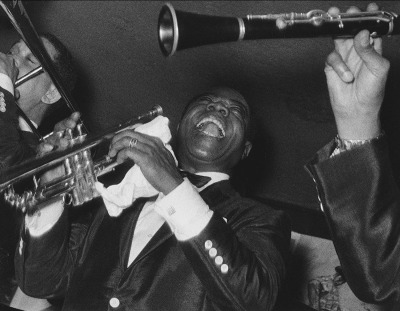
Louis Armstrong by Lisette Model
Negli stessi anni avrei anche appreso che Armstrong era accusato di essere uno ziotomista e che a giudicarlo tale erano spesso proprio gli uomini di colore. Eppure era noto il suo aperto e concreto sostegno alla battaglia di Martin Luther King e le sue prese di posizione antigovernative contro le politiche dell’epoca, che contribuivano a rendere i neri americani di serie B. Altrettanto noti erano sul piano musicale peraltro, i giudizi espressi nei suoi confronti da artisti del calibro di Miles Davis, per il quale nessuno sarebbe stato mai capace di suonare la tromba come Armstrong, un maestro assoluto dunque dello strumento. Di tono non dissimile erano le valutazioni di altri eccezionali musicisti che hanno fatto la storia del jazz, come Duke Ellington.
Quanto invece alla schizofrenia che ha accompagnato il mio rapporto con Armstrong e la sua musica, per fortuna appartiene al passato, soppiantata dalla consapevolezza di dover respingere ogni considerazione astratta, poiché guarda alle cose come dotate di una sola dimensione. Satchmo era nipote di schiavi e conosceva bene il razzismo e la condizione di emarginazione e povertà che comporta, per averla vissuta in prima persona. Sua madre, abbandonata dal padre del musicista, era costretta a prostituirsi per far sopravvivere i suoi figli e la stessa vita giovanile del jazzista non è da considerarsi un esempio, sebbene quando si parla della vita dei neri in America, si dovrebbe tener conto del fatto che la possibilità di scegliere per sé la vita migliore era ed è sottoposta alle pesanti limitazioni determinate dal razzismo ancora e sempre imperante. Armstrong ha usato il linguaggio dell’epoca alla quale è appartenuto e sarebbe irragionevole (anche se astrattamente possibile) aspettarsi che ne usasse uno nuovo, diverso e più giusto o che addirittura ne inventasse uno.
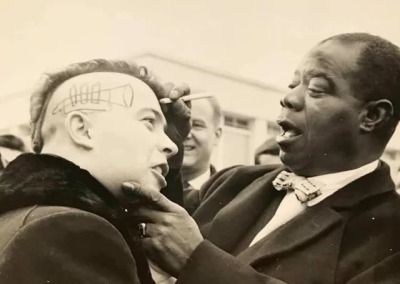
Louis Armstrong signing a fan’s head in Nice, France 1961
Più volte egli stesso ha dichiarato di fare solo ciò che piaceva al pubblico. Talvolta bisognerebbe fare i conti con una dimensione umana che accompagna sempre anche figure di eccezionale valore, che finiamo col considerare degli eroi al di sopra del tempo, dimenticando che il più delle volte i miti degli eroi sono creati a fini propagandistici e che abitano le pagine dei libri molto di più che le strade delle nostre città. L’eredità di Satchmo attiene al suo contributo all’evoluzione del linguaggio del jazz e deve essere valutata e giustificata in sé come fatto di straordinario valore, a prescindere dalle scelte che come essere umano è stato in grado di fare. Ovviamente ciò vale se si è appassionati di musica e ad essa in qualche modo ci si dedichi, non se si ambisce a valutazioni delle condotte umane, nelle quali anche pretenziosi istituti come il Sant’ Uffizio hanno dimostrato di saper solo fallire.

English Version
Did Louis Armstrong’s Smiles Benefit the Cause of Black Americans?
At six or seven years old, I was in love with “Hello Dolly” and “When the Saints Go Marching In,” the famous songs made popular by Louis Armstrong. I noticed that my father smiled too whenever Armstrong appeared on TV, even though neither he nor I knew anything about jazz. There was indeed something in the trumpeter’s pieces that was impossible not to love, but equally difficult to put a name to. This happened with almost every piece he chose to make his own, and it was always this quality that guaranteed him the worldwide fame he enjoyed—a fame that required him to be present everywhere, even in places far removed from the world of jazz he came from and to which he always belonged.
My passion for Armstrong, however, faded completely once I reached adolescence: I would see him performing at Sanremo in old footage, smiling, and I would ask myself what a Black artist could possibly have to laugh about while performing for white people—that “master race” that had been capable of enslaving his people, tearing them from their own land. I obviously did not condemn his choice to perform, but rather the choice to do so without ever stopping smiling for even a minute, an excess that seemed to me typical of someone who feels they must give something extra, because there exists within them a debt they’re used to settling only in that way. I objected to this manner, just as in certain films I couldn’t stand that Black people were never the protagonists, and the few times they were, it always happened within a cliché not so different, all things considered, from the one Louis Armstrong offered with his smiles. Black people, from what I could see through film or television, always behaved differently than white people did in the same contexts. Some time later I would discover that the attitude I found unbearable as a girl was called, by many, “Uncle Tomism.” Uncle Tomism thus consisted of Black people maintaining the behavior they themselves believed pleased white people—indeed, moving exclusively within those patterns chosen for them by white people in their role as masters.
In those same years I would also learn that Armstrong was accused of being an “Uncle Tom,” and that it was often Black men themselves who judged him as such.
And yet his open and concrete support for Martin Luther King’s struggle was well known, as were his anti-government stances against the policies of the time, which helped keep Black Americans as second-class citizens. Equally well known, on the musical front, were the assessments made of him by artists of the caliber of Miles Davis, for whom no one would ever be able to play the trumpet like Armstrong—an absolute master of the instrument. Similar in tone were the judgments of other exceptional musicians who made jazz history, such as Duke Ellington.
As for the ambivalence that accompanied my relationship with Armstrong and his music, fortunately it belongs to the past, replaced by the awareness that one must reject every abstract judgment, since it looks at things as though they had only one dimension.
Satchmo was the grandson of slaves and knew racism well, along with the marginalization and poverty it brings, having lived it firsthand. His mother, abandoned by the musician’s father, was forced into prostitution to keep her children alive, and the jazzman’s own youth should not be considered an example—although when speaking of the lives of Black people in America, one should bear in mind that the possibility of choosing the best life for oneself was, and still is, subject to the heavy constraints imposed by racism, which remains as dominant as ever. Armstrong used the language of the era he belonged to, and it would be unreasonable (even if abstractly conceivable) to expect him to use a new, different, and fairer one, or even to invent one himself. He himself repeatedly stated that he did only what the audience liked.
Sometimes we need to reckon with a human dimension that always accompanies even figures of exceptional worth—figures we end up regarding as heroes above and beyond time, forgetting that, more often than not, the myths of heroes are created for propagandistic purposes and inhabit the pages of books far more than the streets of our cities. Satchmo’s legacy lies in his contribution to the evolution of jazz language, and it must be evaluated and justified on its own terms as a fact of extraordinary value, regardless of the choices he was able to make as a human being. This holds true, of course, if one is passionate about music and devoted to it in some way—not if one aspires to pass judgment on human conduct, an area in which even pretentious institutions like the Holy Office have shown themselves capable only of failing.


Sullo ‘ziotommismo’ di Armstrong ci sarebbe molto da dire. L’uomo sorrideva molto, ma era tutt’altro che uno sprovveduto. Non dimentichiamo che lo showbiz americano dagli anni ’20 fino ai primi ’60 era pesantemente infiltrato dal Syndacate, poi Cosa Nostra, non a caso Armstrong si scelse come manager un uomo che veniva dalle fila di Al Capone, “l’interlocutore giusto per l’ambiente giusto”, come ebbe a ribattere una volta a chi gli eccepiva la cosa. Quanto alla sua vocazione di show man, era autentica ed incontenibile. uno dei suoi pochi malumori noti riguardava il fatto che Fletcher Henderson non gli consentiva di cantare nei concerti e nelle registrazioni della sua band. Che Louis abbandonò presto senza molti rimpianti (“non sa che cosa si perde”, commentò). Armstrong assurse a livelli di notorietà sulla più ampia scena americana che noi oggi non riusciamo nemmeno ad immaginare: ed amministrò con grande oculatezza la sua immagine pubblica, del tutto irraggiungibile per gli altri artisti neri, spesso confinati in ambiti ristretti e razzialmente definiti. Ciò non gli impedì nel 1957 di fronte alle violenze di Little Rock contro gli studenti neri ammessi per la prima volta all’univesità statale di inviare un telegramma a dir poco rude e ‘colorito’ all’allora Presidente degli Stati Uniti. Che altri non era che Eisenhower, il grande stratega della vittoria alleata in Europa, quello che dopo aver dato l’ordine finale per il D-Day in mezzo ad una tempesta stese subito la lettera di dimissioni in cui si assumeva interamente la responsabilità del probabile disastro. Mica Badoglio…. ed Eisenhower, uomo del Sud, alla fine mandò la Guardia Nazionale in Arkansas.
Infine c’è il capitole delle ‘missioni culturali’ organizzate dal Dipartimento di Stato, che utilizzava disinvoltamente i jazzmen come ambasciatori dell’American Waay of Life nel mondo: nonostante ‘robuste pressioni’ non ci fu verso di convincere Armstrong ad andare in tourneè in Sudafrica appena dopòo il massacro di Sharpeville del 1960. Quanto agli oscuri retroscena dell’epocale viaggio in Congo dello stesso anno, rinvio allo sconvolgente documentario ‘”Soudtrack for a Coup d’Etat”. Milton56
"Mi piace""Mi piace"